Audio Cues and Their Role in Shaping Bet Timing Across Virtual Hold'em Platforms
Eden Lange · Aug 7, 2026

Audio Cues and Their Role in Shaping Bet Timing Across Virtual Hold'em Platforms
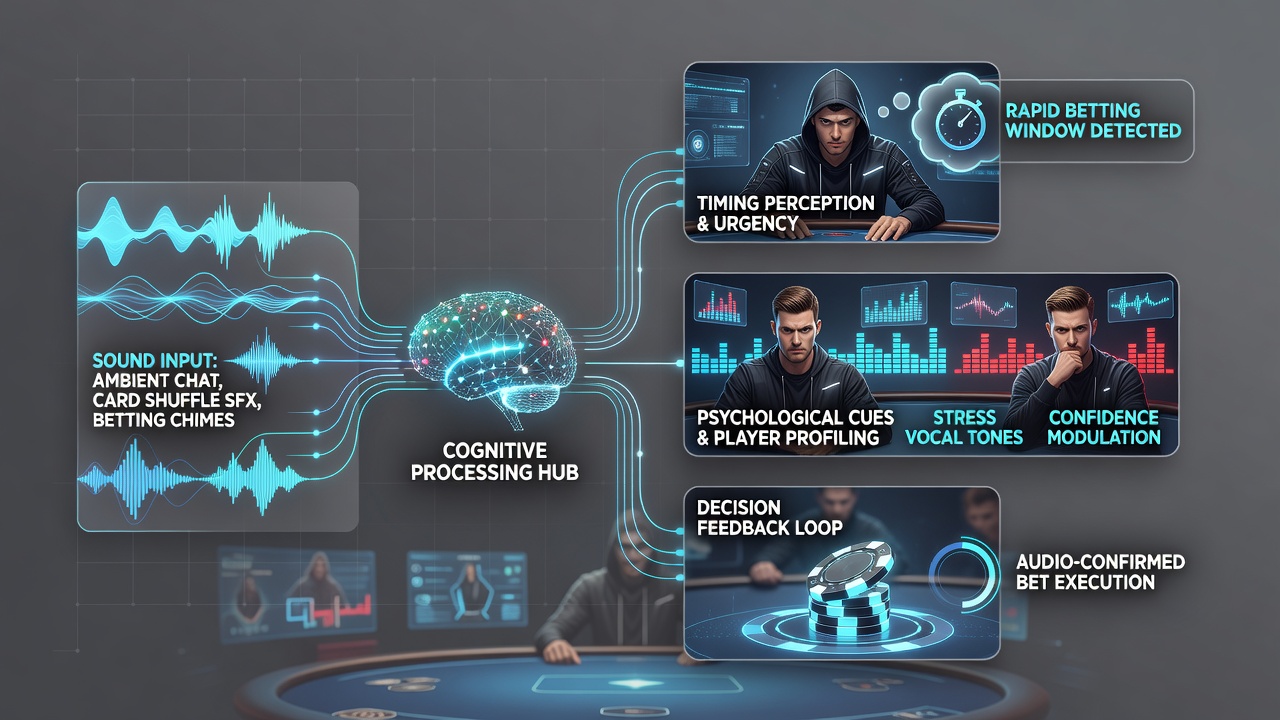
Virtual Hold'em environments rely on layered sound design to guide player interactions, and researchers have documented clear connections between specific audio elements and the pace at which participants place bets. Chip clinks, card shuffles, and tension-building tracks appear in synchronized patterns that align with decision windows, while data from platform analytics in August 2026 shows measurable shifts in average response times when these cues change.
Core Sound Components in Multiplayer Sessions
Chip handling audio forms the most immediate cue, and studies indicate that sharper, higher-pitched clinks correlate with faster bet placements because they signal urgency without additional visual prompts. Card flip sounds serve a different function; softer, drawn-out releases often precede longer deliberation periods, giving players extra moments to process community cards before committing chips. Ambient layers such as low-frequency drones or rising string notes build across betting rounds, and platform logs reveal that these elements stretch decision intervals by several seconds on average when volume and tempo increase together.
Alert tones for raises or all-ins introduce another variable. Short, staccato bursts tend to compress reaction windows, prompting quicker folds or calls, whereas sustained chimes extend the time users spend reviewing stack sizes and pot odds. Multiplayer servers track these patterns across thousands of hands each month, and the resulting datasets demonstrate consistent timing adjustments tied directly to the acoustic profile rather than hand strength alone.
Timing Patterns Observed in Networked Environments
Platform operators collect granular timing metrics that separate pre-flop decisions from later streets, and cross-referenced audio logs show distinct clusters. Hands accompanied by accelerating background rhythms exhibit compressed pre-flop timing, while post-flop rounds with steady, neutral tones allow wider spreads in action speed. Observers note that these variations hold across different stake levels and player pools, suggesting the influence operates independently of experience or bankroll size.
Regional latency interacts with these audio cues in measurable ways. Sessions routed through higher-latency nodes sometimes compensate with earlier or more pronounced sound triggers, and analysts tracking August 2026 traffic patterns found that adjusted audio timing helped stabilize bet placement rates even when connection delays occurred. Developers adjust these parameters through server-side configurations that respond to average ping data without altering the underlying game rules.
Research Findings on Audio Influence
Investigations conducted by academic groups have isolated sound as a variable in controlled multiplayer simulations. One project from the Canadian Institute for Gaming Research examined response distributions across identical hand sequences presented with and without dynamic audio, and the results indicated statistically significant differences in mean decision duration. A separate analysis referenced by the European Gaming and Betting Association examined real-world tournament data and identified similar trends, particularly in progressive formats where sound intensity ramps with each betting round.
These studies emphasize correlation rather than direct causation, yet the patterns remain robust across sample sizes exceeding ten thousand hands. Interface designers incorporate the findings by calibrating volume curves and frequency ranges to avoid unintended acceleration or delay in player actions, and ongoing platform updates in 2026 continue to refine these settings based on aggregated telemetry.
Implementation Across Different Platforms
Free-to-play networks and real-money sites apply sound design with varying intensity. Some environments keep audio optional, allowing users to toggle layers independently, while others embed cues as default settings that cannot be disabled. Data indicates that players who retain full audio experience more uniform timing distributions, whereas those who mute elements show greater variance in bet placement speed. Tournament organizers monitor these differences because they affect overall session flow and leaderboard stability during extended events.
Sound libraries have evolved to include region-specific variations, and developers test how subtle changes in timbre affect global player bases. The consistent outcome across tests remains a measurable link between acoustic feedback and the temporal structure of betting decisions, independent of individual skill or strategic preference.
Conclusion
Sound design functions as an active component within virtual Hold'em systems, shaping the temporal framework in which bet timing decisions unfold. Platform data, academic examinations, and operational adjustments throughout 2026 confirm that specific audio elements produce repeatable effects on decision pacing across multiplayer environments. These relationships continue to inform interface refinements as operators seek to maintain consistent interaction patterns for diverse player groups.