Bounty Pressure Influencing Range Construction Across Free Tournament Platforms
Otto Berger · Aug 24, 2026

Bounty Pressure Influencing Range Construction Across Free Tournament Platforms
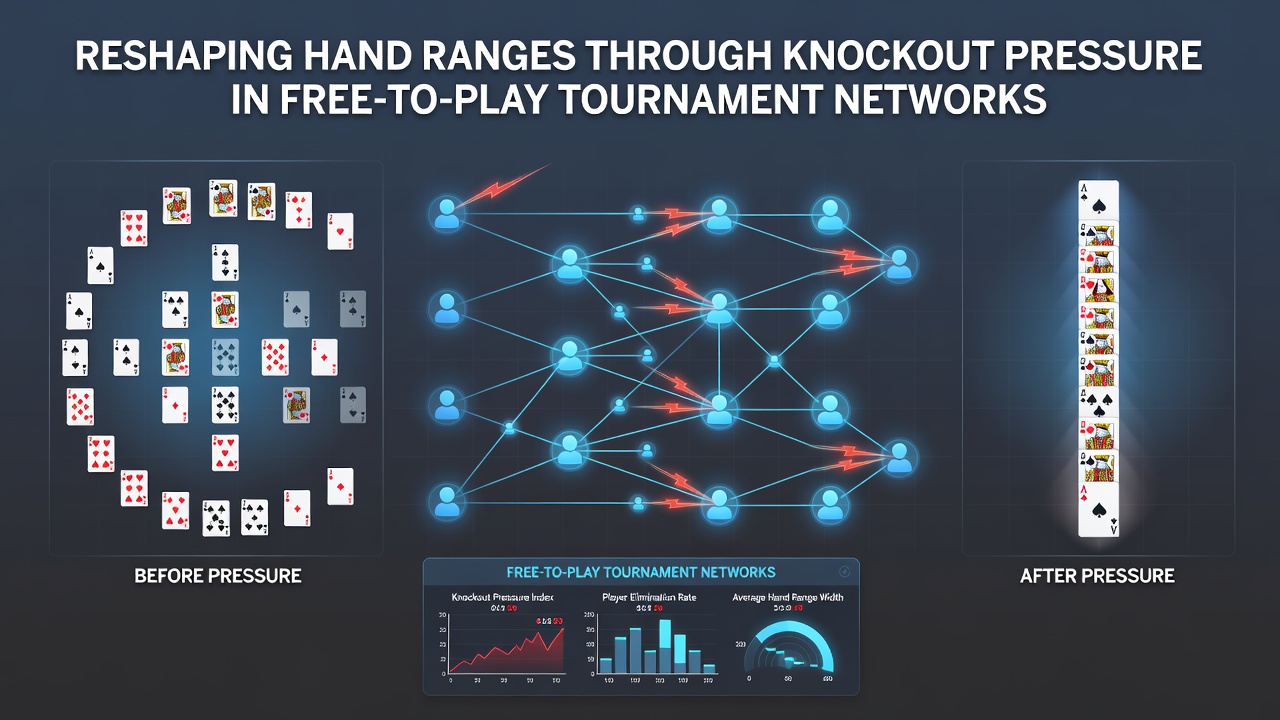
Free-to-play tournament networks have introduced knockout formats that attach direct value to player eliminations, and observers note these mechanics prompt measurable shifts in starting hand selection. Data from multiple platforms indicates participants widen ranges early when bounties represent a meaningful portion of total prize pools, while tightening selections once stacks stabilize and bounty opportunities decrease. Researchers tracking session logs across several networks found that players facing immediate knockout pressure call wider preflop than in standard freezeout structures, particularly from late positions where positional advantage compounds the bounty reward.
Knockout Incentives and Early Stage Adjustments
Progressive knockout formats divide bounty value between immediate cash and remaining stack equity, creating layered decision trees that standard tournament theory does not fully address. Figures released by network operators show average voluntary put money in pot percentages rising by double digits in the first few levels of bounty events compared with regular multi-table tournaments. Those who study aggregated hand histories observe that suited connectors and small pairs gain frequency because the implied odds from bounties offset the reverse implied odds that normally discourage speculative holdings. And yet the same datasets reveal that premium pairs retain their dominance because the risk of early elimination outweighs the potential bounty harvest when stacks remain deep.
Mid-Stage Range Compression Under Accumulating Pressure
As tournaments progress and average stacks shorten relative to blinds, knockout pressure begins to reshape ranges from the opposite direction. Players who have accumulated bounties often tighten their opening ranges to protect the equity they have already banked, whereas shorter stacks increase all-in frequency to chase remaining targets. Session data collected during August 2026 events across several free-to-play networks demonstrates that the frequency of three-bet shoves rises sharply once players reach the middle stages, especially when multiple bounties sit at the same table. Analysts examining these patterns note that suited ace-x hands appear more often in shoving ranges because they retain decent equity against calling ranges while still offering knockout upside if they hold.
Platform telemetry further reveals that regional latency differences can amplify these adjustments, since delayed decision windows sometimes force players into wider calling ranges when they cannot gather full information on opponents' tendencies. Studies conducted by the Nevada Gaming Control Board on simulated tournament environments have documented similar patterns, confirming that time pressure interacts with bounty mechanics to alter perceived hand strength.
Position and Table Dynamics in Bounty Environments
Table composition exerts additional influence on range construction once knockout incentives enter the equation. Participants seated to the immediate left of large bounty targets tend to defend wider against steals because the potential reward justifies the risk, whereas those positioned with short stacks on their right often fold more marginal holdings to avoid giving away bounties. Aggregated statistics from international free-play networks indicate that button and cutoff ranges expand by roughly 8 to 12 percent when at least one player at the table holds a bounty exceeding 30 percent of the average stack. Conversely, under-the-gun ranges contract because early position raises face multiple defenders who may each hold bounty motivations.
Experts reviewing leaderboard data across 2026 seasons have identified that players who consistently adjust ranges according to bounty distribution climb higher in seasonal standings than those who apply static strategies. One dataset released by the Canadian Gaming Association highlighted that participants who tracked bounty sizes and adjusted opening frequencies accordingly recorded higher average finish positions across repeated entries.
Conclusion
Network operators continue to refine bounty structures and payout splits, and ongoing data collection shows that hand range adaptation remains central to performance in these environments. Observers tracking free-to-play tournament networks expect further evolution in how players balance immediate knockout value against long-term stack preservation as formats mature through the remainder of 2026 and beyond.