Shifting Rhythms of Decision Fatigue in Progressive Bounty Formats Across Time Zones
Eden Lange · Jul 20, 2026
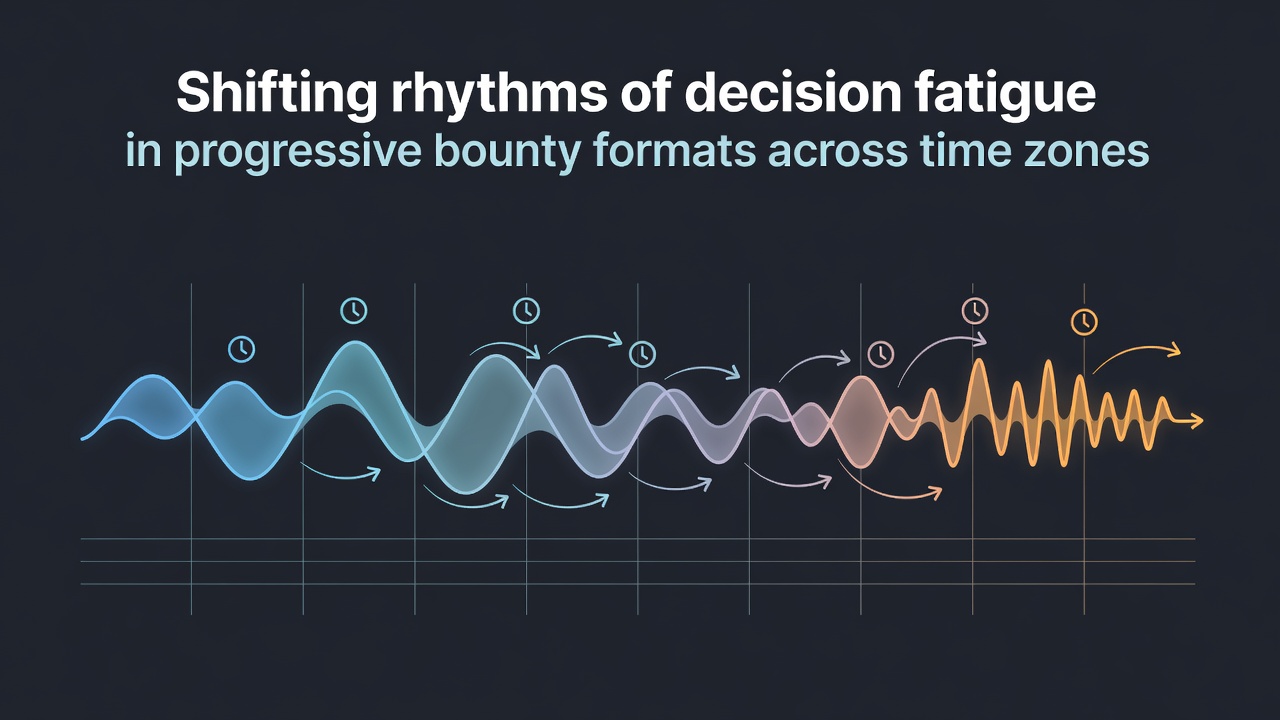
Shifting Rhythms of Decision Fatigue in Progressive Bounty Formats Across Time Zones
Progressive bounty formats have gained traction in online poker networks because they tie increasing rewards directly to eliminations while the base prize pool remains structured around survival and position. Researchers tracking these events note that decision fatigue emerges differently when participants log in from regions separated by multiple hours because their local circadian rhythms dictate alertness levels even as the tournament clock advances uniformly. Data collected from major platforms during 2025 and into July 2026 shows measurable drops in bet-sizing precision and fold-frequency consistency after roughly four hours of continuous play regardless of starting time.
Mechanics of Progressive Bounties and Cognitive Load
Progressive bounty structures begin with a fixed bounty on each player that grows whenever that player eliminates others creating an escalating incentive layer on top of standard tournament mathematics. This added variable increases the number of calculations required per hand because participants must weigh immediate bounty value against future stack preservation and payout implications. Studies from cognitive performance labs indicate that the dual-task demand of tracking both chip equity and dynamic bounty values accelerates mental depletion compared with freezeout or standard rebuy events. Those who have examined hand histories from large fields report that early-stage aggression often gives way to more conservative ranges once cumulative decision volume rises and that pattern holds across multiple time zones when adjusted for local sleep cycles.
Time Zone Effects on Alertness Patterns
Players competing from Asia-Pacific regions frequently enter events that align with evening hours in the Americas while European participants may join during morning or afternoon slots. Observers tracking reaction-time metrics across servers note that decision latency increases by an average of 1.8 seconds per hand after the sixth hour for participants whose local time corresponds to their typical sleep window. Figures compiled by international gaming research groups reveal that networks spanning UTC+8 to UTC-5 experience staggered peaks in suboptimal calls and missed value bets precisely when overlapping sessions cross into the second or third time-zone cohort. In July 2026 several large progressive bounty series recorded these shifts most clearly during late-night blocks for North American entrants who had already been awake for extended periods.
Observed Fatigue Rhythms in Multi-Region Data
Analysis of server logs demonstrates that fold equity utilization declines steadily once individual session length exceeds five hours and the rate of decline steepens when local circadian lows coincide with high-stakes bounty chase phases. One dataset covering tournaments with over 5,000 entrants showed that participants from eastern time zones posted higher continuation-bet frequencies during their afternoon hours compared with the same players competing after midnight local time. Meanwhile cohorts based in western Europe maintained tighter ranges longer when events started during their morning but exhibited quicker erosion of discipline once afternoon fatigue set in. These patterns emerge consistently across platforms yet remain independent of individual skill levels according to aggregated performance metrics.
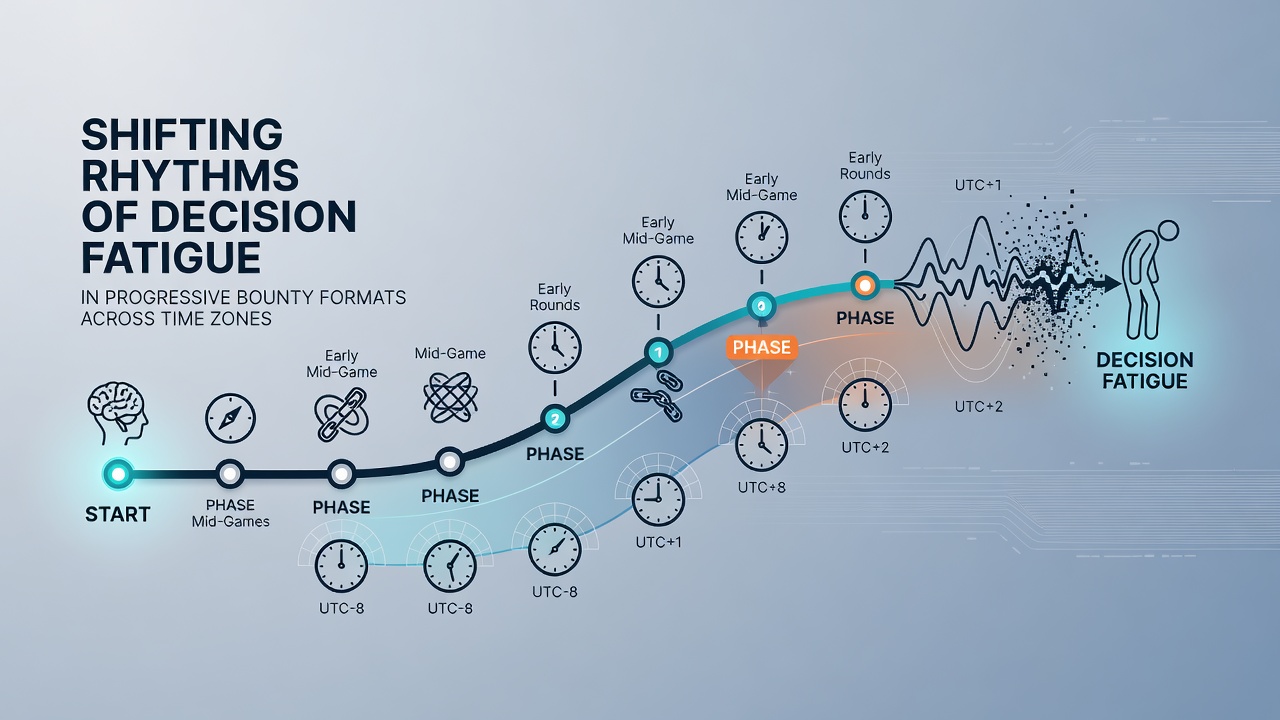
Additional findings from university-affiliated psychology departments link progressive bounty pressure to elevated cortisol markers in controlled lab simulations of tournament decision trees. When researchers overlay these physiological signals onto actual tournament timestamps they find that the steepest fatigue curves appear among players whose local time falls between 2 a.m. and 6 a.m. during the later stages. The same studies document that brief breaks or hydration interventions produce temporary rebounds in decision quality but the overall downward trajectory resumes within thirty minutes for most participants.
Regional Variations and Platform Adjustments
Operators running cross-continent networks have begun adjusting starting times and break schedules to mitigate the most pronounced fatigue windows. Records from several major sites indicate that events seeded during overlapping evening hours for both European and Asian players show more stable late-stage play than those concentrated solely around one region’s night period. Regulatory summaries released by bodies such as teh Nevada Gaming Control Board and the Australian Communications and Media Authority note that player protection guidelines increasingly reference session-duration data when evaluating tournament integrity. These reports highlight correlations between extended play and variance spikes without attributing causation to any single factor beyond cumulative cognitive load.
Industry organizations tracking online poker trends report that bounty-format participation continues to rise while average session lengths remain stable around seven to nine hours for deep runs. The data further shows that participants who rotate through multiple time-zone friendly start times maintain higher average ROI than those locked into single-region schedules. Such patterns underscore how external timing variables interact with the internal demands of progressive bounty mechanics.
Conclusion
Longitudinal tracking of decision fatigue in progressive bounty formats reveals clear rhythmic shifts tied to time-zone alignment and local circadian position. Evidence gathered from platform logs academic simulations and regulatory summaries demonstrates that fatigue accumulates faster under bounty pressure and accelerates when sessions overlap with typical sleep periods for any given cohort. As networks continue expanding global reach these temporal dynamics remain central to understanding performance distributions across large fields.